Mack Lab poster presentations at VSS this year!
Saturday, May 18, 2024, 8:30 am – 12:30 pm
- Investigating the representational transformations underlying the learning of exceptions in visual categories
- Dory Xie, Emily Q. Wang, Yao Chen, Michael L. Mack
Saturday, May 18, 2024,2:45 – 6:45 pm
- Mapping neural similarity spaces for scenes with generative adversarial networks
- Gaeun Son, Dirk B. Walther, Michael L. Mack
Sunday, May 19, 2024,2:45 – 6:45 pm
- EEG-based decoding of shapes and their categories in visual working memory
- Frida Printzlau, Olya Bulatova, Michael Mack, Keisuke Fukuda
Monday, May 20, 2024, 8:30 am – 12:30 pm
- Crossing category boundaries: Perceptual hysteresis for scenes even with endpoint preview
- Huiqin Chen, Mei Yang, Gaeun Son, Dirk Bernhardt-Walther
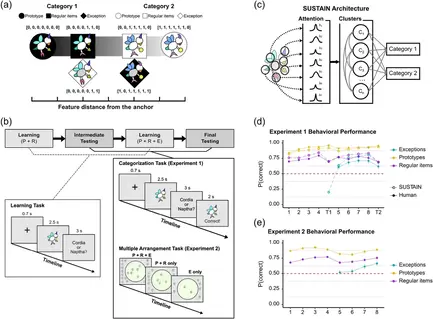
Dory Xie published her first paper in Psychonomic Bulletin & Review. In this work, Dory used novel computational modelling & behavioural approaches to show how selective pattern differentiation and integration support learning and generalization of category exceptions. One interesting wrinkle in the data is that latent representational spaces of category items based on a computational model (thanks again, SUSTAIN!) differ from participants’ similarity ratings. Indeed, whereas the model’s latent space shows that category exceptions are differentiated from items that follow category regularities, explicit similarity ratings suggest participants are simply grouping exceptions with their respective category. Maybe similarity ratings don’t reveal cognition’s latent spaces?
Read it here: https://link.springer.com/article/10.3758/s13423-024-02501-8
The Mack Lab will be all over CNS this year!
Saturday
- Data blitz session 2, 1-2:30pm
** **Talks by Emily Heffernan and Gaeun Son
Sunday
Poster session B, 8-10am
B151: “Cross-participant neural alignment of attentional states during encoding is linked to better memory in adults and children”
Sagana Vijayarajah, Margaret Schlichting
B153: “Menstrual cycle and perceived stress predict performance on the mnemonic similarity”
Mateja Perovic, Michael Mack
Poster session C, 5-7pm
C50: “Interrogating brain engagement as a function of exception learning performance”
Emily Heffernan, Michael Mack
C53: “An edge-centric approach to discerning the neural networks underlying event script processing”
Yongzhen Xie, Alexander Barnett
Monday
Poster session D, 8-10am
D2: “EEG-based decoding of stimulus shapes and their categories in working memory”
Frida Printzlau, Olya Bulatova, Keisuke Fukuda, Michael Mack
D74: “Learning exceptions to category rules is supported by distinct white matter networks”
Melisa Gumus, Nahal Alizadeh Saghati , Michael Mack
D124: “Identifying the neural networks that support categorization using brain-informed drift diffusion modelling
Victoria Liu, Michael Mack
Tuesday
Poster session F, 8-10am
F69: “Effects of BDNF and COMT genetic polymorphism on rule plus-exception category learning at two stages of the menstrual cycle”
Shreeansha Bhattarai, Mateja Perovic, Cathlin Han, Janice Hou, Yao Chen, Michael Mack
F144: “Mapping neural similarity spaces for scenes with generative adversarial networks”
Gaeun Son, Dirk B. Walther, Michael L. Mack
A new paper from Gaeun Son demonstrates how brief category learning of her novel scene wheel stimuli induces category-specific shifts in people’s scene representations. Gaeun had participants first learn to separate scene stimuli from a scene wheel (defined within the latent space of a generative adversarial network, see Gaeun’s earlier paper for more details) into two categories. After category learning, participants were briefly shown the scenes and had to reconstruct them from working memory. Reconstruction errors showed biases away from the category boundary suggesting the category learning warped the representational scene space. Notably, participants who didn’t learn showed no such biases. And, Gaeun replicated the effects in a second study!
This work appears in Psychonomics Bulletin & Review, check it out!.
We are very excited to have Mateja Perovic and Emily Heffernan’s work on exception learning across the menstrual cycle published in Scientific Reports! We found that in a rule-plus-exception category learning task, exception learning performance distinctly varied across the menstrual cycle in a manner consistent with the typical rise and fall of estrogen hormones.
Also, thanks to co-author Gillian Einstein for a great collaboration!
Read the paper here: https://rdcu.be/dtlDi